Showing posts with label Herbal Home Medicine Chest. Show all posts

Friday, June 19, 2020

Herbal Medicine for Emotional Healing: A Book Review


I have high standards for a book to gain some space on my book shelves and this new book with a herbal look at emotional health is worthy. Full disclosure: Tina Sams is a fellow Pennsylvania herbalist who has grown into a good friend but I can assure you I took a critical eye to this book.

This text is written with first person practical experience and the recipes are unique. In this era it seems to many that herbals are a rehash of another publication that is already on my bookshelf and I am pleased to say this one is not.

It begins with a simple overview of herbal preparations and then rolls into chapters focusing on all the many issues surrounding emotional well-being. Obvious issues such as anxiety, stress and depression but also chapters on digestive issues (do you hold your stress in your gut?), skin issues, headaches, circulation, immunity, tense muscles and heartaches. Author Tina Sams took a look at all emotions such as: grief, guilt, heartbreak, moodiness, feeling overwhelmed, sleep and spirit. The final section of the book is a brief alphabetical look at 30 herbs which support emotional healing. There is a resource directory, small glossary and measurement conversions.

The wide variety of recipes and suggestions made in this title is greatly appreciated. The recipes are for both internal and external applications and the instructions are clear and easy to follow. Most of the recipes utilize only 4 to 6 ingredients which makes them very affordable to create.

For me, the lay out is a bit wonky. Personally, I don't like it when recipes continue on the next page.  While there is an index, it could be a bit more comprehensive in my opinion. The table of contents is quite extensive and that helps to make up for where the index is lacking. There are some color photos in the volume and fortunately each of the thirty herb briefs are accompanied by a color image but for the most part this is not a colorful coffee table book. Instead it is a practical, informative and comprehensive book on herbs for emotional healing. And for the list price of $16.99, it is a bargain for the depth of information shared here. The publisher is Rockridge Press.

Another disclosure:  In her acknowledgements Tina Sams wrote a lovely tribute to our mother Bertha Reppert! It was such a pleasant surprise (and brought a tear to our eye as well). Tina spoke to how she felt our mom "set the tone" for the "generous herbal scene" we have here in Pennsylvania and beyond. A herbal scene that "continues to grow, evolve and welcome new herbies".  It is so kind of Tina to both remember her and recognize her, twenty years after her passing. We are blessed.

Thursday, June 6, 2019

Rose Petal Witch Hazel Astringent

Rose Petal Witch Hazel Astringent --
It is so easy to make a lovely facial toner/astringent. Simply fill a jar 1/3rd full with dried organic rose petals or 1/2 full with fragrant fresh organic rose petals. We like to use the old fashioned rosa rugosa roses. Pour your favorite Witch Hazel astringent over the petals and allow the petals to steep for about a week. The Rose Petals will be mostly white by then.  Strain them out and they get added to the compost bin. Label your lovely witch hazel and use as a skin toner/astringent.   We make small batches and use it up. It is very fragrant.   Calendula petals are very healing for the skin. Aloe Vera is lovely.  Rose feels very cooling to us and we like to wipe our faces with a cosmetic pad dipped in Rose/Witch Hazel Astringent on hot summer days.

Monday, April 4, 2016

Tea with Herbalist, Rosemary Gladstar

Rosemary Gladstar recently traveled to The Rosemary House to present an herbal seminar that included sessions about Backyard Medicine: Weeds of Wonder and Herbs for Natural Energy & Vitality. Prior to the seminar, Susan Kiskis, author, yogini, speaker & whole health guide interviewed Rosemary for an article in her online magazine, Freedom Journal. Susan has graciously granted permission to share the article with our readers. Thank you, Susan! And an extra special Thank you, Rosemary for the outstanding presentation.

Tea with Herbalist, Rosemary Gladstar
by Susan Kiskis, April 3, 2016
Known as the “Godmother of American Herbalism,” Gladstar sat down for a cup of lemon balm and chamomile tea blended by The Rosemary House & Gardens owner, Susanna Reppert-Brill. Wearing her trademark moon pendent necklace, dressed in purple, her warmth reflects a nurturing instinct. Despite the late hour, and a delayed flight into Harrisburg, the Vermont resident spoke enthusiastically about her lifelong commitment to herbal medicine.

“Everything evolved from my love and passion of plants,” she says about her extensive mark on the herbal world.

Born and raised on a dairy farm in Sonoma County, California, Gladstar was heavily influenced by her maternal Armenian grandmother, Mary.

“When my grandmother would weed, she would be weeding and putting these plants into her basket and she would be telling us, you know, how these plants were used and then she would cook them up into food.”

Mary and her grandfather met on the death march in Armenia. She told the young Rosemary, God and plants saved her life.

Her passion for plants was further cultivated by her family's faith. Members of the Seventh-day Adventist Church, Gladstar was drawn to books from authors from her faith, one of them being Back to Eden, by Jethro Kloss. The groundbreaking book on healing herbs, published in 1939, along with church co-founder Ellen Gould White, who also wrote about herbal and natural healing, helped to shape Gladstar's growing passion. That influence supported her decision at the age of 13 to become a vegetarian, a path she still follows today.

After years of backpacking and living in the backwoods of the U.S. and Canada, Gladstar eventually settled back in California where, due to the lack of herbal access, founded Rosemary's Garden, a retail herbal store in 1972. As customers lined up, the interest in knowing herbs more intimately also blossomed. She started teaching small groups, eventually forming one of the oldest, and still surviving herbal school in the U.S., California School of Herbal Studies, in 1978.

Following in the footsteps of Kloss and White, Gladstar authored 12 books on herbal healing and co-authored an additional one. From the classic, Herbal Healing for Women to the more current, Rosemary Gladstar's Medicinal Herbs: A Beginner's Guide: 33 Healing Herbs to Know, Grow, and Use, Gladstar has influenced a generation of herbal enthusiasts. Despite her ambitious career she says, she is modest about her legacy.

“I just serve the need.”

Gladstar never set goals to become an author or entrepreneur, yet life enfolded before her. In 1974, Gladstar and environmentalist Drake Sadler, founded Traditional Medicinals. The company today, no longer run by Gladstar, still ranks their top product sales with her original 13 blends. From "Smooth Move" to "Gypsy Cold Care," Gladstar still cares for those who don't know her name, but understands the connection of herbal remedies to a healthy lifestyle.

In 1991, she co-founded the Northeast Herb Association and just a few years later, Gladstar founded, United Plant Savers, a non-profit that serves to protect native medicinal plants in North America and their habitats.

Looking at her 44 year career, an outsider would conclude she is a chronic entrepreneur, an author and advocate. However, just skimming through the foundation of each project, you can easily see how herbalism seeded the genesis of each one.

“I've never looked at it from that perspective,” says Gladstar. “I've always looked at it as I'm an herbalist and all of those things, out of being an herbalist, that naturally grew. I was just an herbalist and there was a need for it.”

Today, Gladstar lives on a 500 acre botanical preserve and farm in Vermont where she runs Sage Mountain Herbal Retreat Center. The 67 year old still travels offering workshops to want-to-be herbalists and garners tens of thousands of views on YouTube with her herbal how-to videos.

For more information on Gladstar's retreat center, programs and travel journeys, visit sagemountain.com.

Tuesday, November 19, 2013

Elderberry Syrup - DIY

It's time to make your Elderberry Syrup and stock your herbal medicine cabinet for the long winter. Fortunately, we have do it yourself kits available online or in the shop so you can make your own. Be prepared for the cold and flu season using nature's bounty. Our friend, Nancy, aka Lemon Verbena Lady shares her syrup making adventure on her blog post here.
 
With cold and flu season around the corner - it's important to become familiar with Elderberry.
Elderberries have been a folk remedy for a variety of ailments for centuries in North America, Europe, Western Asia, and North Africa.  Elder keeps viruses away by blocking the virus from entering the cell itself because it's stabilizing the cells.  All flu viruses have trouble with Elderberry's blockades.  Elderberries contain organic pigments, tannin, amino acids, carotenoids, flavonoids, sugar, rutin, viburnic acid, Vitamins A, B, and a large amount of C.  Flavonoids, including quercetin and anthocyanin are believed to account for the therapeutic actions of the elderberry flowers and berries. 

Monday, November 4, 2013

Warmth on a Winter Day


  Mulling Spice Elixir
2   Cinnamon sticks 
2 T  Allspice    
1  Nutmeg nut 
1 T  Ginger, dried 
1  Vanilla bean
6 c. Apple juice
½ c   Raw Sugar
½ c  Brandy

Make a decoction of the spices by simmering them in the apple juice for one hour. Then add the raw sugar to sweeten while it is warm. Mix well. To every quart add ½ c Brandy. The Mulling Spices simmering on the stove can also serve to invoke the senses and warm the spirit.  These warming circulatory, stimulating spices keep the blood pumping even while enjoying the great outdoors  during winter. Have a wee bit of Mulling Spice before your next winter walk or sledding expedition and experience the tingling in your toes as something other than frost bite. 

Recipe from our friend and fabulous herbalist Teresa Boardwine of Green Comfort Herbal Education

Sunday, November 3, 2013

Throat Lozenges

There are many lozenge recipes available and they are all very good.   I just find this sore throat lozenge candy so easy to make.  The herbs we chose were Marshmallow Root and Slippery Elm Bark.  Both are very mucilaginous (slimy) and soothing for the throat.   Simmer the roots in water for 30 minutes.  Since these are roots you want to decoct them in the water, which means the water needs to be moving or simmering.  Steeping is not strong enough to extract all the medicinal properties.   Strain out the herb and put 2 C of that herbal tea back in the pot.  Add 2 C of sugar and boil the two together until it reaches 300 degrees on a candy thermometer.  Use a deep pan as it really expands when boiling.  It takes quite a bit of time for it to reach about 280 degrees but then it shoots up to 300 very quickly.    When at 300 degrees pour onto a greased and confectioner covered cookie tray.  Cut into pieces as soon as you can lift it up.   The color is all natural from the tea.  You can add flavoring to it if you desire - we used natural orange flavor.   You can play around with this recipe, changing the herbs that are used as the base tea.  Horehound is a favorite for sore throats.  Rose Hips offers a reddish tint to your lozenges and Wild Cherry Bark is fabulous for sore throats so that is a winning combination as well.  When you suck on these slowly you can feel a smooth coating on your throat. 

Saturday, November 2, 2013

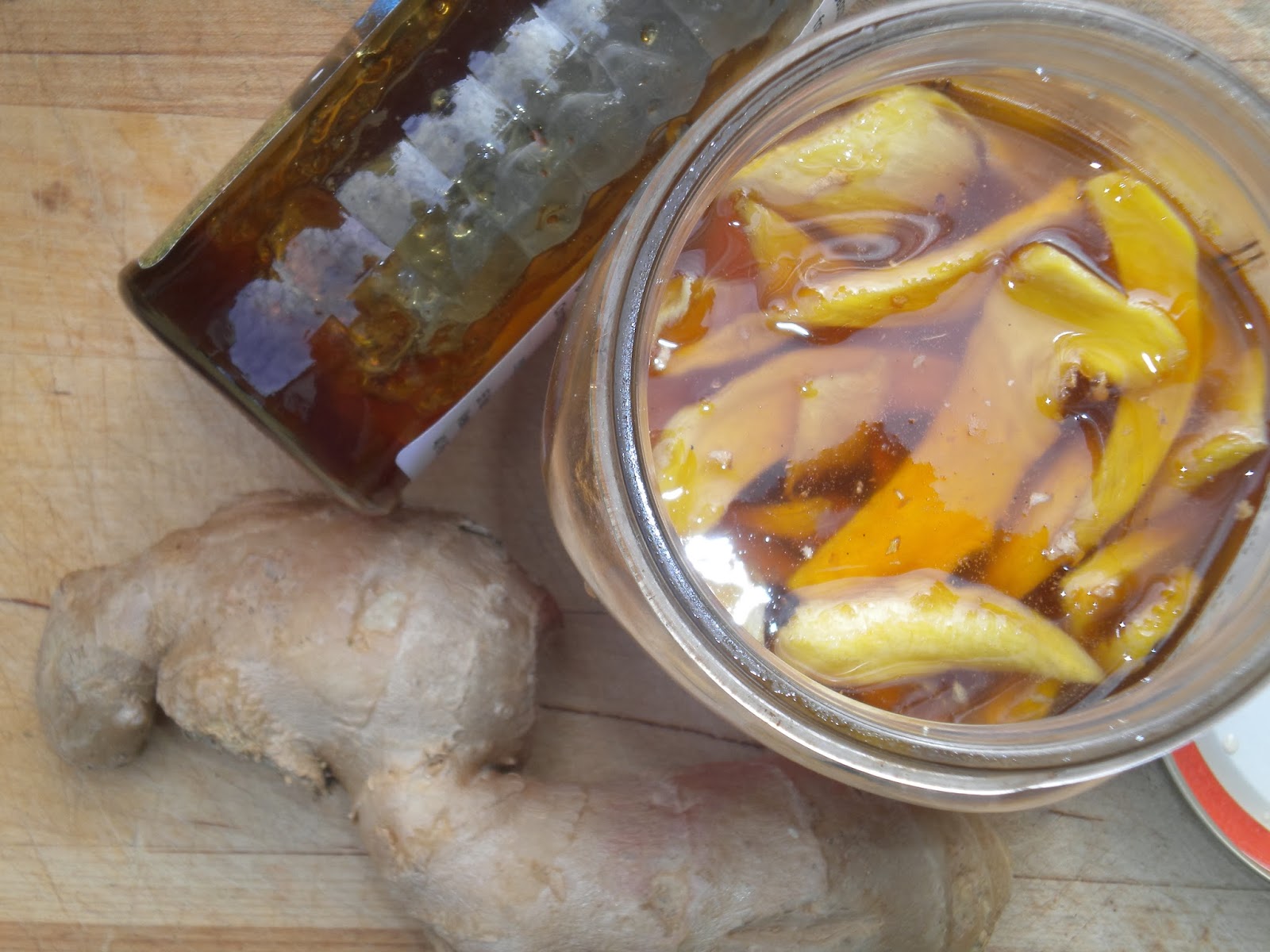
Ginger Honey Syrup

This is so fun and so easy to do.  Peel and slice the whole ginger root (say about 1 C) and add it to your wide mouth jar.  Add in 2 C  honey, making sure the ginger is covered, and let rest for a week or so.  The honey immediately begins pulling the juices out of the ginger to create a syrup.  It doesn't take long at all until the honey is the viscosity of a syrup.  At this point it is time to pour off the syrup and reserve the ginger for stir fries.   Honey is a great preservative but since it has been altered,  I add some smooth brandy to it as an additional preservative.   One cup of Brandy per quart of the elixir is a good proportion.   Use this honey to sweeten your tea or add to your Fire Cider or add to any other formula to sweeten it.    This same recipe will also work with lemons in place of the ginger.

Friday, November 1, 2013

Fire Cider

Fire Cider is based on the Vinegar of the Four Thieves, which we covered a few years ago in this blog.   This is a pared down version but still just as healthy for winter time ills.   (And according to my children - much more palatable!)  It is very easy to make with Apple Cider vinegar, onion, horseradish, garlic, ginger and a pinch of cayenne.  Simply peel and chunk the horseradish, garlic, and ginger and add them to a wide mouth jar with a pinch of cayenne.  It needs to be full but not packed tight.  Pour in the cider vinegar and let rest for a month.  Strain and add honey to taste.  To this size jar we added about a generous 1/4 C of honey.  Take 1 teaspoon every 1/2 hour during your fight with illness.  

Thursday, May 23, 2013

Elder - Herb of the Year - 2013

Tina Sams, editor of the Essential Herbal Magazine and the one in pink "photo bombing" Susanna, coordinated the publication of a new book on Elder.  Written by six different women herbalists, this fun little book covers all aspects and uses of Elder, the Herb of the Year for 2013.  Everything from growing to medicinal, to liqueurs and cordials, to candies, to syrup and on and on, elder in the kitchen or elder lore, it is all here in this 40 page book (or available as a down load too).  Tina Sams and Susanna often vend near each other at different herb festivals, to find them you just listen for the laughter!  So a friendly competition was developing on who could sell more of this fabulous book.  

There are over 30 recipes, crafts and remedies in this book.  Lots of fascinating folklore and quality photos to help you identify Elder.  This six friends share all their favorite uses for elder flowers and elder berries in this well indexed book. 

Saturday, January 26, 2013

NYC Chinatown Herb Shops


During our free time in Chinatown, we poked our heads in a number of herb shops.   Fun to see and smell but also overwhelming at times since we can't read Chinese.  The one above is the shop of an Acupuncturist.  Very pretty place the drawers on the left all contain loose herbs which they will measure out for you.  The boxes on the right are patent medicines herbal, mineral, animal and I  am not sure what else really.

 
This sleek shop above sold fragrant herbal soaps, shampoos, and eye shadows, nail products - all beauty oriented.
  We stopped at another herb shop full of shelves stocked with herbs in glass jars (reminiscent of The Rosemary House) where we found these Indian long pepper corns (Piper longum).  They taste a bit hotter then their cousin black pepper (Piper nigrum) and you can use them in your pepper grinder.  She also had smoked peppercorns which had a wood fire smoke fragrance to them. 
One of my goals was to restock my supply of Moxa Sticks.  Moxibustion is a traditional Chinese style of  healing by warming the acupuncture points or by warming areas in your body where you may be stiff or sore.  You light the end of the stick and smudge over your victim patient until there is a large red area and the patient says it is getting very warm.  The moxa stick which is made of the herb mugwort (Artemisia vulgaris) works by stimulating circulation of the blood flow and the qi. Many mid wives will use a moxa stick to help to turn a baby who is not positioned head down in the last weeks of the pregnancy. 

Monday, October 18, 2010

Pam Montgomery

We were honored to welcome Pam Montgomery of Plant Spirit Healing and Partner Earth Education for our 2010 workshop on medicinal herbs. Pam taught an experiential class using the gardens of The Rosemary House as the classroom. We went beyond the chemical constituents of the plant to creating a bond with the plants and thereby reaching the very source of a plants healing abilities.
Pam Montgomery is the author of Plant Spirit Healing: A guide to Working with Plant Consciousness. Her approach to this is very systematic and scientific as well as deeply spiritual.
Pam received training from the Empire State College in Alternative Health Education. She is the originator of Green Terrestrial Herbal Products of Vermont ans was one of the founding members of the Northeast Herbal Association. Active in United Plant Savers and a major organizer of Green Nations Gathering. Our thanks to Pam Montgomery for bringing a wealth of experience and knowledge to our shop. Beautiful weather, wonderful knowledge, delicious lunch by Nancy equals a perfect day!
One of the seminar attendees, Tina Sams of The Essential Herbal shares her experience on her blog.

Wednesday, July 7, 2010

Wild Birch 'Tea'

Sweet Birch 'Tea' (Betula lenta) is a light pleasant summer time or any time drink. It has a sweet old fashioned wintergreen chewing gum flavor. You can use red birch (pictured here) which will make a pale red colored beverage or you can use white birch (Betula papyrifera). They both have the same flavor. Simmer* covered a small handful of the twigs in 2 quarts of water for about 25 minutes or to desired strength. Add 3/4 C of sugar (or less). Tasty hot or iced.

Birch trees have a long history of use in the US. The Native Americans used the bark of the white birch to make tee pees and also to make canoes. The flavorful bark provided toothbrush and mouthwash all in one! The sweet birch was the original source of wintergreen flavor and one of the many ingredients in root beer.


* Whenever you make tea with barks, roots, mushrooms or even seeds it is a boiled or simmered decoction and not a steeped infusion. So it is important to keep the water moving by simmering. Some mushrooms need simmered for a really long period of time so we will do that in the crock pot. Infusions are made with the leaves and flowers of the herbs.

Saturday, October 17, 2009

Preparing for Winter Colds/Flu: onion poultice

Add onions to your grocery list so that you have some on hand for any chest congestion that should arise. This was one of our mother's very favorite and might I add quite effective remedies for congestion and unproductive coughs. Simply dice the onions and saute them in a frying pan. Add a splash of olive oil and some garlic too if you have it. A dash of thyme and pinch of oregano helps too. When the onions are translucent then put half of them on the chest of your victim (err, I mean patient). We put down a wash cloth first, then the onions, then cover the person and onions with a towel or blanket to keep warm. Allow patient to rest and watch their favorite movie or TV show -- that's our bribe for cooperation for this treatment around here.
Now with the reserved half of the onion, garlic, and olive oil add some pieces of chicken, broccoli, cauliflower and continue to cook...... that's for dinner. Multi-tasking - that's how it all gets done!

This treatment is very effective. It is warming and loosens and moves the congestion that can collect in your lungs. Very safe to do on all ages, an external application so no need to worry about drug/herb interactions. If you feel a cold settling in your kidney area you could apply the onion there as well. One word of warning: Between the onion, garlic, olive oil and herbs we add such as thyme and oregano, you do end up smelling a bit like an Italian hoagie!

Friday, October 16, 2009

Preparing for Winter Colds/Flu: Yarrow and Boneset


Every fall, I always gather, dry, and tincture these two herbs and pray that we won't need them. Boneset (above) and Yarrow (below) are two of my favorite herbs to use in tea or tincture form for colds/flues. Boneset is helpful for that awful achy feeling -- you know where even your big toe hurts. Easy to recognize out in the field because it looks like the stems have been pushed up through the leaves. Boneset, Eupatorium perfoliatum, will also help to induce sweating in addition to helping with the aches and pains of a flu.
Yarrow, Achillea millefolium, is useful for treating severe colds and for ending fevers. It is a strong diaphoretic (promotes sweating).


To prepare mix 1/2 oz of each herb boneset and yarrow and steep covered in 1 pint of water. Drink it as warm as you can in 4 oz doses. Sweeten with honey if you like. Also, add some peppermint for additional flavor.

It's like carrying an umbrella. If you have some on hand-- you won't need it! But if you do need it -- you'll be glad you had it on hand!

Thursday, October 15, 2009

Preparing for Winter Cold/Flu: Four Thieves Vinegar

This picture features the ingredients in Four Thieves Vinegar. But first the story! There are many versions of this tale and here's mine: Long Ago (1700's) in a Land Far Away (France) there were 4 naughty men who were robbing the graves of Black Death plague victims. At first the authorities showed no concern certain the thieves would contract the deadly disease and close the case themselves. But the Four Thieves continued their rampage on not only graves but the homes of the weak and dying. The story continues, and when they were finally captured, the (fill in the blank here: Burgess, Mayor, Noble, King) offered their freedom in exchange for their secret to avoiding the plague. The secret was the use of herbs in vinegar which they either consumed or soaked their bandannas in to cover their face or did both.
There are as many different versions of the recipe as there are versions of the story.
Here is one version:
2 T each of the following herbs Rosemary, Sage, Lavender, Wormwood, Peppermint, and Rue in 1 pint of Vinegar.
Some versions include garlic as well.
Our version is 2/3 C Horseradish, 1 red onion, 2-3 Garlic bulbs, 12 sage leaves, two thyme sprigs, 1 rosemary sprig, pinch of ginger and 1 pint of vinegar. Blend it all in the blender and bottle. It will look frothy like this but in the morning will be a powerful medicine. This is a strong blend. You can mix it with some water to drink it down. Certain to ward off H1N1 and any other pandemic.....

Wednesday, October 14, 2009

Preparing for Winter Colds/Flu: Sage Honey

Regular old garden Sage (Salvia officinalis) is excellent in poultry stuffing, wonderful with sausage, can be used as a rinse on your hair to keep your hair dark in color and is medicinal as well. Used as a tea or tincture to reduce excessive secreations: such as sweating, dripping sinuses, and mother's milk of a weaning mother. One of my other very favorite uses is as a herbal honey for sore throats. We had a quick but productive two days with Jessica from Blackbirds Daughter and one of the concoctions to prepare for the winter months was Sage Honey. Jessica prepared hers by filling 1/4 of a jar of fresh sage in the blender with honey and blending the two together. You can gently heat the honey (note: heating honey too much lowers the enzymes) and strain the herbs out if you want. Thyme honey can also be made in addition to sage herbal honey for sore throats or hoarseness or respiratory aliments. While raw honey is richer in enzymes we usually use pastuerized honey. Ridiculously easy to make and so yummy too. So don't eat it all at once!

Tuesday, October 13, 2009

Preparing for Colds/Flu: Elderberry

Elderberries have been getting a fair bit of press lately for their ability to fight colds and flues as they are quite rich in flavinoid anti-oxidants which boost the immune system and filled with anthocyanins which have an anti-inflammatory effect helping with aches, pain and fever. So in preparation for winter we harvested the elderberries and made some elderberry syrup.
Being from the "Mary Poppins School of Medicine" (a teaspoon of sugar....) this is one of my very very favorite winter remedies. It tastes like liquid candy.....Just ask my kids!

Take 1 T syrup daily (see recipe below) to prevent cold/flu. If you do catch a "bug" then take 3 T daily to speed recovery.

Intern Jessica (find her at Blackbirds Daughter), cheerfully removing the elderberries (Sambucus Canadensis nigra) off the branches.

Later she created a number of different syrups. Recipes follow:
The Basic Recipe
2 C fresh berries
1 C honey
2 C water

Bring to a boil. Reduce heat, cover and simmer for 25 minutes or so until the liquid is reduced.

You can make your syrup with white sugar or agave or you can also add many spices to the syrup.

Another version of the recipe:
2 C fresh berries
5 cloves
2 small cinnamon sticks
1 T fresh ginger root (particularly nice to add because of it's warming effect when you are ill)
1 vanilla bean
1 C honey
2 C water

Bring to a boil. Reduce heat. Cover. Simmer for 20 minutes until some of the liquid is reduced. Strain and store in the fridge.

Sunday, October 11, 2009

An adventure with the Hops Vine

We have a very large hops vine (Humulus lupulus) that we grow to cover our little greenhouse and provide cool shade in the summer. If we don't keep up with pruning the hops it will climb up into our cedar tree and even out the electric wires toward the street. It comes up from the ground every year and can easily reach 100 feet in one growing season! Naturally the flowers are up at the top so it became an adventure to pull down the aggressive hops vine, save the cedar tree, and harvest the chartreuse strobile flowers.

Yanking down the hops, steadily and slowly. Commercial growers wisely grow hops on strings only about 6 feet tall or so for ease of harvesting.

Some of the gorgeous harvest. The fluffy cone flowers are used to make beer, to stuff sleep pillows or to be tinctured.

Medicinally, hops is used to aid with sleep. Dried hops are frequently used to stuff little pillows, along with the pleasantly fragrant herb lavender to help aid sleep. Mugwort can be added to this blend to help increase dreaming. Pictured here is some of the hops tincture. Hops has a potent aroma (some describe it as dirty socks....) so after some discussion thought it best to tincture the hops in a spicy rum. Clever intern Jessica also created an even stronger sedative tincture with hops and Valerian in Scotch whiskey. Which she is calling Valerian-Hops-Scotch!

Monday, July 27, 2009

St. John's Wort

Saint John's Wort, shown here blooming in the garden, has been used for centuries for nerve pain, anxiety and mild depression. It is an effective remedy but is is suggested you try it for 3 to 4 weeks before deciding whether it works for you. We usually suggest a tincture made of the plant instead of the capsules. I love to make Red oil with Saint John's Wort. Pick the flowering tops of Saint John's Wort and place them in a wide mouth jar. Add enough olive oil so that it rises 2 to 3 inches above the herb. Place in a warm sunny location for 4 to six weeks. Strain and use it topically on any wound, swelling, bruises, sprains, etc. The oil should be a deep blood red, the redder the better.

Wednesday, October 29, 2008

Castor Bean

Ricinus communis, a tropical ornamental plant, grown as an annual in southcentral PA, and will reach only about 10 feet in height. A large fast growing plant, it provides a lovely foliage screen over the summer months. Shown here are the flowers. The fruit which follows is a capsule containing three large seeds which are the source of commercial Castor oil. The dark seeds are shiny and extremely poisonous.
Castor bean oil is one of the best known laxatives and probably one of the least liked. Old timers remember its yucky flavor and odor but this is the new millennium and Castor oil now comes both tasteless and odorless. Its laxative action is gentle and suitable for children and the aged.
Castor oil is one of the most water soluble oils available so it is useful in making a scented oil to add to the bathtub. Simply mix 1 C of some of the tasteless/odorless Castor oil together with 1/4 ounce of your favorite essential oil such as lavender or lemon. Voila, a quick, easy and fun holiday gift!