Sunday, April 22, 2012

Wild Thyme Tea Party

Penn Cumberland Garden Club recently hosted their 48th Annual Bertha P. Reppert Herb Tea Party. This is a wonderful event and always one of the most well attended meetings with over 100 attending! Every year the Herb Tea Committee selects a different theme and creates a menu and decorations surrounding that theme.  Our theme this year was wild weeds as food. It was called a Wild Thyme Herb Tea. The flower arrangers of the club used garlic mustard and spring onions in the centerpieces and all the foods featured edible plants we often call "weeds" but that are most nutritious. Our speaker was Tina Sams of The Essential Herbal Magazine and her topic was "Making Friends with Your Weeds".   Tina shares her thoughts about the tea and additional photos on her blog, linked here.  The featured tea sandwiches were:  Toasted Weed Sticks, Tansy Egg Sandwich, Chickweed Mini Pie and  Red Clover Bread with blackberry spread.
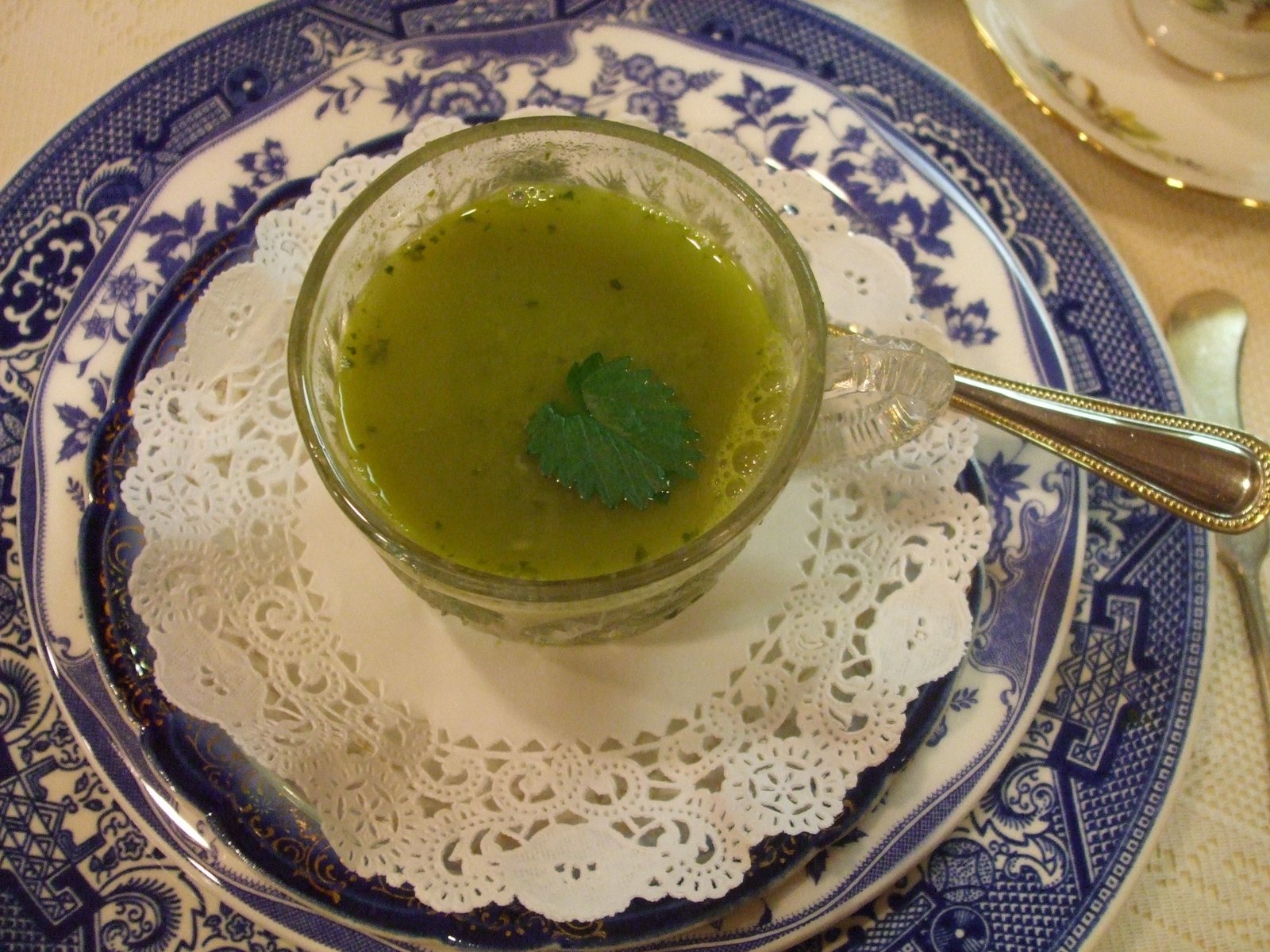
The Nettle Soup was probably my favorite part of the menu.  Nettle stings when you gather it so it is a challenge to make this soup but it was sooooo good!  I could even see this soup used as a sauce on pasta.  Nettle is amazingly rich in iron, nourishing for the blood and often used for seasonal allergies.
Nettle Soup Recipe
1 pound stinging nettles
2 teaspoons salt
1 tablespoon extra virgin olive oil
1 white onion, diced
1/4 cup basmati rice
4 cups chicken broth
salt and pepper to taste
Directions
Bring a large pot of water to a boil with 2 teaspoons of salt. Drop in the stinging nettles, and cook 1 to 2 minutes until they soften. This will remove most of the sting. Drain in a colander, and rinse with cold water. Trim off any tough stems, then chop coarsely.

Heat the olive oil in a saucepan over medium-low heat, and stir in the onion. Cook until the onion has softened and turned translucent, about 5 minutes. Stir in the rice, chicken broth, and chopped nettles. Bring to a boil, then reduce heat to medium-low, cover, and simmer until the rice is tender, about 15 minutes. Puree the soup with an immersion blender, and season to taste with salt and pepper.

Here's a fun way to serve veggies and dip for a crowd.  No need to worry about double dipping with this serving method! The Watercress Dip was served in an individual glass votive with celery, carrot and asparagus sprigs.

Saturday, April 21, 2012

Lessons of the Lorax

Leave it  to Dr Seuss to teach us an Earth Day Lesson.

Happy Earth Day!  Care today and everyday! 

Saturday, April 14, 2012

Eliza Blackwell Dupree ~ our guest

We were pleased to welcome Eliza Blackwell Dupree, a fictional survivor of the Titanic, as our guest speaker for the evening.  A captivating and engaging speaker, Miss Dupree drew the audience into the events of this tragic night with her stories and her thoughts.  Luxury and increased travel were the hallmark of this era, with travel either by steam ship or by train.  There was a First, Second, and Third (steerage) class for both.  However, steam ship travel was dependent upon the weather, so an exact date to set sail could not be provided.  She also explained about the fashion of the time, columnar shaped gowns, well balanced, and a very large hat.  The size of the hat was directly proportional to your amount of wealth.  Quite a statement.

"It was a brilliant crowd. Jewels flashed from the gowns of the women. The soft, sweet odor of rare flowers pervaded the atmosphere. The orchestra played popular music. it was a rare gathering of beautiful women and splendid men." ~First-class passenger Mrs. Jacques Futrelle

Friday, April 13, 2012

Recreating Dinner Aboard the Titanic

 Last night marked our commemoration of the 100th anniversary of the maiden voyage of the Titanic.  In an effort to recreate and experience a bygone era of luxury and leisure, setting the scene and presenting a sense of occasion is just as important as recreating the fabulous foods served on board.  Our tables included a scrolled menu, gaily tied with a fresh sprig of rosemary, symbolic for remembrance.  Bowls of spiced pecans and sugar crystals along with fresh flowers graced the elaborately decorated tables.  Small dishes held the toppings for the scones, lemon curd, clotted cream, and sweet violet confiture.
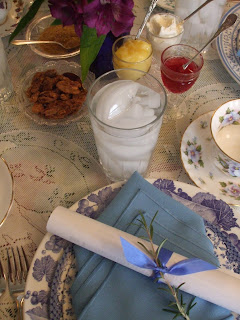
A First Class Titanic Dinner might include nine courses.  Our simple fare started with Macedoine de Fruits, a fresh fruit cup marinated in a sweet mint sauce and topped with sugared almonds.

Following the first course, we served a Spring Pea Soup, Potage Saint-Germaine.  This light soup is made from a puree of fresh green peas, romaine lettuce, and fresh parsley and garnished with a burnet leaf.  The menus aboard the majestic liner were heavily influenced by the French cuisine.

Our third course featured Asparagus Salad with Champagne Saffron Vinaigrette.  The Titanic was noted to be one of the first ocean liners to make fine food a priority, including the best fresh food. Over 800 bundles of fresh asparagus were stored on board.  
A platter of Canapes included Roast pork with peach Conserve, Canapes a l'amiral (shrimp hor d-oeuvres), and Asperges printanieres (Spring Asparagus Sandwich) with Crystallized Grapes.


We served fresh from the oven Traditional English Cream Scones dusted with confectioners sugar and garnished with star fruit to be enjoyed with the clotted cream, lemon curd, and sweet violet confit.
No Edwardian meal was complete without a selection of sweets.  And our dessert course included Petit Choux a la Almond Creme and a Coconut Sandwich that is known to have been served in the Second Class dining hall.


"On the night of the wreck our dinner tables were a picture!  The huge bunches of grapes which topped the fruit baskets on every table were thrilling...I stayed at the table from soup to nuts."
 -Second-class passenger Kate Buss


Wednesday, April 11, 2012

Remembering The Titanic

 This week marks the 100th anniversary of the maiden voyage of the Titanic and the fateful sinking of a ship that was widely touted as unsinkable.  The book, Last Dinner on the Titanic shares menus and recipes that would have been served on this majestic liner.  The authors, Rick Archbold and Dana McCauley offer ideas and suggestions on how to host your own dinner party to honor this historic event.  They dedicate this book 'to the memory of all those who prepared and served the food aboard the R.M.S.Titanic'. The ship carried the most advanced culinary facilities afloat.  With three huge galleys and a staff of 80, they toiled around the clock to prepare nearly 6,000 meals a day for the passengers aboard.   French influenced fare would be majestically presented in the splendid restaurant creating a culinary drama while a hearty stew might be served in the third-class dining area.
 Preparations for our special event at Sweet Remembrances are underway.  Course after course, from Macedoine de fruits to Asparagus Salad with Champagne Saffron Vinaigrette to second class Coconut Sandwiches, we hope to honor those that toiled in the kitchens and respect their dedication to preparing and presenting a sumptuous repast.

 'It was a brilliant assembly, contentment and happiness prevailed.' ~First-class passenger Elmer Taylor.

Monday, April 9, 2012

Stepping back in time!

 In January of 2005, Janet Young of Over the Teacup (shown here on the right) with Nancy and Susanna Reppert of The Rosemary House and Sweet Remembrances, joined forces and founded the Mid-Atlantic Tea Business Association (MATBA) in an effort to help tea related businesses network together, share ideas and concerns, and provide educational opportunities to those interested. 


We contacted business owners and tea enthusiasts to learn about our new endeavor and to join the association.  Our first gathering was held at Sweet Remembrances in June, 2005.  our featured guest was Bruce Richardson, author and speaker from The Elmwood Inn.  He presented two programs, one entitled "From Bush to Cup - How Tea Gets to You", and on the second day, he presented "What's Hot in Tea". 

One of the guests in attendance that day was Phyllis Barkey (shown here, to the right of Shelley Richardson).  Phyllis traveled from Michigan to attend this event.  Although not a member of the MATBA, Phyllis has an enthusiastic interest in all things tea and has recently started blogging.  She details her experience at Sweet Remembrances in her blog post today.  Please visit Phyllis at Relevant Tea Leaf for her review of her visit to the tea room.  The pictures take me back a few years!

Sunday, April 8, 2012

Rejoice!

Easter spells out beauty, the rare beauty of new life. ~S.D. Gordon

Saturday, April 7, 2012

First Saturday Afternoon Tea - April

 The sandwich plate for the First Saturday in April included bunnies and eggs and all things spring!  There was a rosemary chicken salad, egg shaped cucumber sandwich with French style cheese spread, asparagus sandwich with egg yolk butter, and a carrot ginger bunny topped with sprouts.  Scones, of course.  And dessert included a lemon tartlet topped with a fresh edible violet, peanut butter filled bunnies atop colorful Easter grass, and an Italian cream cupcake with a petite nest of jelly beans.  Festive and fun!  Hope your day has been the same!

Friday, April 6, 2012

Crown of Thorns

Euphorbia millii (nicknamed Crown of Thorns) is native to Madagascar and legend tells us this plant was what was used to make the crown of thorns that Christ wore.    Evidence shows that the plant did migrate to the Middle East many years prior to the time of Christ. This plant is a woody, climbing succulent that thrives in hot climates and is tolerant of both heat and drought.  It flowers almost all year and can reach up to 6 feet in height.  The thorns can reach 1 to 2 inches in length. Here in Pennsylvania, it is a houseplant.   The exact plant species that was used to make the crown of thorns is not specified in the Bible.   Interestingly, the thick stems can be intertwined...... 

Thursday, April 5, 2012

Passion Flower

One of our most exotic native American flowers  is often considered a world wide symbol of Christ's Passion. Emblematic of faith and piety, the mystical Passion Flower repeats the drama of Easter in its stunning waxen blossom. This flower is so extraordinarily beautiful that one can understand why the early Spanish explorers and Christian missionaries were overcome by its glory, so much so that they endowed its intricate structure with all the symbolism that has now become an accepted part of the legend of the Passion Flower.   The five petals and five sepals are said to represent the ten apostles (excluding Judas and Peter, the doubtful one), the three parted leaves symbolize the Holy Trinity, the three stigmas are said to look like the three nails; each stamen resembles the cross and the arrangement of the stamens together is in the form of the cross.  The central column or style represents the pillar to which Christ was bound for the scourging and the many tendrils of this climbing plant are the whips and cords.  The leaves are referred to as spear shaped. The double corona of 72 purple filaments which form an exquisite fringe within the flower are representative of the crown of thorns. The vigorous growing strong vine is compared to the Gospel and of course the lavender and purple colors of the passion flowers are the colors traditionally associated with Lent and Easter.
Gorgeous, Medicinal, Edible, and Symbolic - we are lucky to be able to grow a variety of this plant in our garden!

Monday, April 2, 2012

Natural Dyed Eggs

Not only are these eggs dyed with natural plant dyes but they have wax drawings on them.  The wax doesn't absorb the plant dyes and then highlights the design in a pleasant lighter color.    Some of the plants that can be used to dye your Easter Eggs include: 

Red Onion Skins - our personal favorite, yields the dark mahogany colors.  You can use the same dye bath a second time with another dozen eggs to achieve the lighter russet shades.  We usually just boil the eggs and the onion skins together so that we are hard boiling and dying at the same time.  You can find instructions and photos at our post called Eggcitement.

Turmeric - gives the very cheerful yellows

Red Cabbage leaves - Dyes eggs the blueish shade

You can also use: Black Tea (beige), fresh or frozen Spinach (green), fresh, frozen or canned blueberries (blue), canned cherries with juice (pink) and many others. 
If you don't want to boil the eggs and the dye together - the other option would be to make a liquid dye.  You can do this by Bringing 1 quart of water to a boil with up to one or two hand fulls of plant material.   Once it is boiling, reduce the heat and simmer for 15 minutes or up to an hour until you achieve the color you like.  Strain.   For each cup of liquid dye add 1-2 Tbsp. white vinegar to set the color.   Place your prepared dye bath in any glass container leaving room to add your already hard boiled eggs you wish to dye. 

Have fun dying eggs the old-fashioned way!